Partitioning, sharding and consistent hashing
TL;DR
- Partitioning (sharding) splits a dataset across nodes so no single machine holds all the data or serves all the load; replication copies each partition, and real designs do both.
- The partition key decides everything: it must match the dominant access path, spread load evenly and survive nodes joining and leaving without remapping most keys.
- Interviewers probe the key you chose, your hot-partition plan, how secondary-key lookups are served, and what moves when a node joins.
Core concepts
You shard when one node can no longer hold the data or absorb the load. A single relational primary sustains ~5k-20k writes/s and a server holds 2-20 TB, so a Twitter-like post store (150M posts/day x 1 KB = 150 GB/day, ~55 TB/year) must partition within its first year on storage alone, before its write rate (1.7k/s average, 5k/s peak) forces it.
Range vs hash partitioning
Range partitioning gives each partition a contiguous, sorted key interval, so a range scan touches one or a few partitions. Its weakness is correlated keys: a timestamp or auto-increment key sends every insert to the last partition, where at 5k posts/s peak one partition takes 100% of the writes — and a DynamoDB partition is capped at 1k WCU.
Hash partitioning places a key by hash(key), so 5k writes/s over 16 partitions is ~300/s each, at the price of order: a range query becomes a scatter-gather over every partition. The compromise is a compound key — hash the first component to pick the partition, sort by the rest inside it. (user_id, timestamp) keeps one user's messages on one partition in time order (Cassandra's clustering columns, DynamoDB's sort key). Design the key so the dominant query is the within-partition kind.
Follow the dominant query to a scheme, then handle the hot key separately.
flowchart TD
    q_start["Partition key = the dominant access path"] --> q_range{"Dominant query is a range scan on that key?"}
    q_range -->|"yes"| q_mono{"Key monotonic (time, sequence)?"}
    q_mono -->|"no"| s_range["Range partitioning:<br/>sorted intervals per shard"]
    q_mono -->|"yes"| s_compound["Compound key:<br/>hash(user_id) + range(timestamp)"]
    q_range -->|"no"| q_place{"Explicit placement needed<br/>(tenants, mixed hardware)?"}
    q_place -->|"yes"| s_dir["Directory-based:<br/>tenant or partition to shard map"]
    q_place -->|"no"| q_elastic{"Nodes join and leave often?"}
    q_elastic -->|"yes"| s_ring["Consistent hashing<br/>with virtual nodes"]
    q_elastic -->|"no"| s_fixed["Fixed partition count P:<br/>hash(key) mod P, partitions mapped to nodes"]
    s_range --> q_hot{"Hot key or hot range?"}
    s_compound --> q_hot
    s_dir --> q_hot
    s_ring --> q_hot
    s_fixed --> q_hot
    q_hot -->|"hot reads"| h_rep["Replicate or cache the key"]
    q_hot -->|"hot writes"| h_salt["Salt the key, fan in on read"]
    q_hot -->|"no"| h_ok["Ship it, alert on per-partition load"]
Hotspots: celebrity keys, skew and salting
Uniform hashing evens out keys, not traffic. Access is Zipfian: a viral post can draw most of a Twitter-like system's ~500k peak feed reads/s, and one Redis shard serves ~100k ops/s, so that key alone is 5x one shard's capacity however you partition.
- Hot reads: replicate the key — an in-process cache, or k suffixed copies (
post:9#0..k-1) so readers pick one at random and k shards share the load. - Hot writes: salt the key with a random suffix
0..k-1per write, spreading a counter over k partitions. Reads must fan in and sum k rows, so salt only keys you have measured as hot (a heavy-hitters sketch), never the whole keyspace.
Secondary indexes: local vs global
A local (document-partitioned) index lives on each shard and covers only that shard's rows. Writes stay on one shard; a lookup by the indexed value (users by email when sharded by user_id) scatters to every shard, so its latency is the slowest of N parallel calls — with 100 shards, your p99 is the worst of 100 samples — and its cost is N requests.
A global (term-partitioned) index is itself partitioned by the indexed value: the index shard for hash(email) returns the user_id, then the data shard returns the row — two hops, ~2 x 500 µs = 1 ms floor. A write now touches the data shard and an index shard, so global indexes are updated asynchronously (as DynamoDB's global secondary indexes are). Rule: write-heavy tables with rare lookups get local indexes; hot lookup paths get global ones and accept the lag.
Local index: one query fans out to every shard. Global index: two hops.
flowchart LR
    subgraph sg_local["Local index, scatter-gather"]
        l_q["find user by email"] --> l_s1["shard 1: own index"]
        l_q --> l_s2["shard 2: own index"]
        l_q --> l_sn["shard N: own index"]
        l_s1 --> l_m["merge results"]
        l_s2 --> l_m
        l_sn --> l_m
    end
    subgraph sg_global["Global index, two hops"]
        g_q["find user by email"] --> g_i["index shard for hash(email)<br/>returns user_id"]
        g_i --> g_d["data shard for hash(user_id)<br/>returns the row"]
    end
Rebalancing: fixed, dynamic or proportional partitions
Rebalancing should end even, move little and keep serving. Rule out hash(key) mod N first: growing from N to N+1 nodes remaps N/(N+1) of the keys — 80% at 4 to 5 — a resharding storm for 25% more capacity. Three schemes avoid it:
- Fixed number of partitions, far more than nodes: 1,024 partitions on 8 nodes is 128 each; adding 2 nodes steals ~26 from each old node, so ~205 partitions (20%) move, always whole ones (Elasticsearch shards, Couchbase vBuckets). Pick the count generously; it is fixed for life.
- Dynamic splitting: a partition splits past a size threshold and merges when it shrinks (HBase regions, MongoDB chunks). Pre-split new tables, which otherwise start as one partition.
- Proportional to nodes: a fixed number of partitions per node — consistent hashing with virtual nodes, below.
Consistent hashing with virtual nodes
Hash both nodes and keys onto a ring of 2^32 positions; a key belongs to the first node clockwise from its position. Adding a node claims only the arc between its predecessor and itself, so about 1/(N+1) of the keys move, all onto the new node; removing a node moves only its own keys, to its clockwise successor.
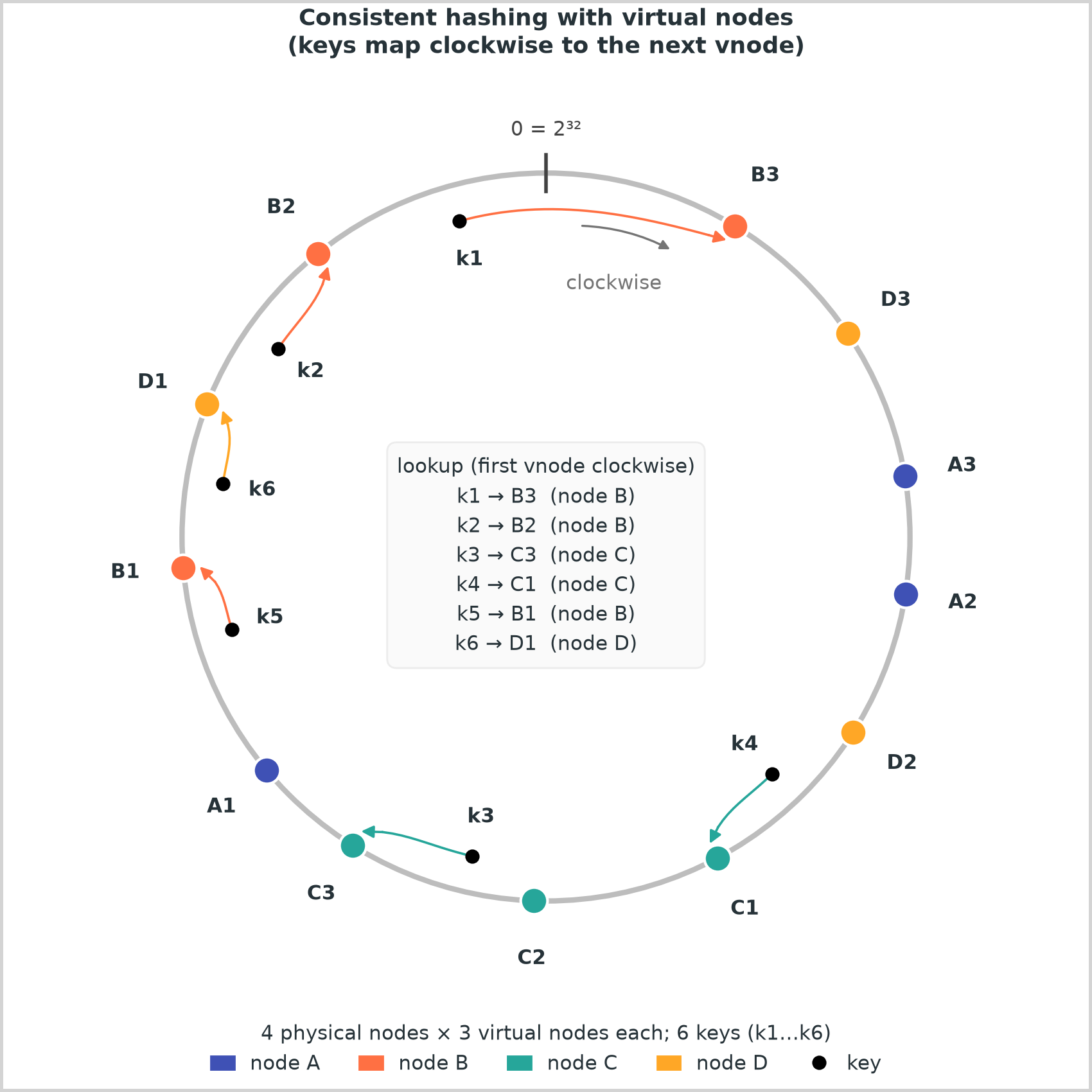
With one point per node the arcs are random and uneven (the demo below measures a peak-to-mean load of 2.20), and a departing node dumps its whole load on one neighbour. Virtual nodes fix both: each physical node gets V points (hash("B#0"), hash("B#1"), ...) and owns V small arcs spread around the ring, as node B does in the figure. Imbalance shrinks roughly with 1/sqrt(V) — 1.03 at V=100 in the demo — and a departing node's keys scatter over many successors. The cost is a sorted table of N x V entries: 100 nodes x 200 vnodes = 20,000 points, one bisect of ~15 comparisons, ~15 x 100 ns = 1.5 µs against a 500 µs network hop. Use a stable, fast hash (Ketama uses MD5; MurmurHash3 and xxHash are common), never a language's built-in hash(), which is salted per process: every client must compute the identical ring.
Replication on the ring
A key's preference list is the first N distinct physical nodes clockwise from it — skip further virtual nodes of a node already chosen and, in production, the same rack. The first is the coordinator, the rest hold replicas, and W writes and R reads among them give the quorums described in Replication. When a node dies, each affected list slides one node clockwise, so the successor takes its writes (hinted handoff).
Request routing: client, proxy or coordinator
Three places can hold the ring:
- Smart client: the client library holds the ring and calls the owner directly — no extra hop, but every client must learn membership changes (config service or gossip) and a stale client hits the wrong node (Cassandra drivers).
- Routing proxy: clients talk to a proxy tier (Envoy, twemproxy) that holds the ring: one extra hop, ~500 µs inside a datacenter, and a tier to operate, but only proxies track topology.
- Any node as coordinator: the client contacts any node, which forwards to the owner or, Redis-Cluster style, answers
MOVEDwith the right address so the client fixes its map.
Smart-client routing with a stale ring: redirect, refresh, then replicate along the preference list.
sequenceDiagram
    autonumber
    participant C as Client library
    participant M as Membership service
    participant B as Node B, owner at ring v7
    participant E as Node E, owner at ring v8
    participant D as Node D, replica
    C->>M: get ring (version 7)
    M-->>C: members and vnode positions
    Note over C: bisect over the ring picks B
    C->>B: PUT key=v (ring v7)
    alt ring unchanged
        B->>D: replicate to next distinct node
        D-->>B: ack
        B-->>C: 200 OK, W=2 reached
    else E joined and took the arc
        B-->>C: MOVED, owner is now E (ring v8)
        C->>M: refresh ring
        M-->>C: ring v8
        C->>E: PUT key=v (ring v8)
        E->>D: replicate
        D-->>E: ack
        E-->>C: 200 OK
    end
Resharding and cross-shard queries
Resharding changes the key-to-shard function itself and is a data migration: create the new shards, dual-write (or tail the change log) while backfilling, verify counts and checksums, move reads, move writes, retire the old shards (see Deployments, feature flags and data migrations). With a ring or a directory only the moved arcs or partitions travel; with mod-N almost everything does, so choose the scheme before you have data.
Queries that omit the partition key pay for it: a scatter-gather fans out to every shard and merges — fine for rare or admin queries, not the hot path. Avoid cross-shard joins by co-locating rows that join (orders sharded by customer_id) or by denormalising; avoid cross-shard transactions with entity groups, otherwise you pay for 2PC or sagas (Transactions, 2PC, sagas and idempotency).
Directory-based sharding
A directory (lookup service) stores an explicit map from key range, partition or tenant to shard. It is the most flexible scheme: move one noisy tenant to dedicated hardware, mark a partition "moving" so the old owner forwards writes mid-migration. The map is small — 10M tenants x ~32 B (16 B UUID, 4 B shard id, overhead) = ~320 MB — so every proxy or client caches it and refreshes on a version bump. The price: the directory sits on every request path and is a single point of failure, so run it on a replicated consistent store (ZooKeeper, etcd, MongoDB's config servers), cache hard, and map partitions, never keys.
Trade-offs
| Scheme | Range scans | Hot-partition risk | Data moved when a node joins | Routing state | Typical use |
|---|---|---|---|---|---|
| Range partitioning | Cheap | High with monotonic keys | Operator-chosen partitions | Boundary table | HBase, Bigtable, time-series |
| Hash mod N | Scatter-gather | Low for keys only | ~N/(N+1) | Just N | Prototypes only |
| Consistent hashing + vnodes | Scatter-gather | Low; salt hot keys | ~1/(N+1) | N x V sorted points | Cassandra, DynamoDB, Riak, caches |
| Fixed partitions + map | Scatter-gather | Low | Whole partitions, ~1/(N+1) | Partition to node map | Elasticsearch, Couchbase, Kafka |
| Directory per tenant | Within a tenant | Tenant-size dependent | Moved tenants only | Tenant to shard map | Multi-tenant SaaS, Vitess |
Start from the query, not the technology. If the dominant access is "all rows for one entity in time order", hash the entity and sort inside the partition: messages, timelines, orders, metrics. If you need scans across entities, use range partitioning and fight the hot tail with a bucketed prefix. If the fleet is elastic — caches, Dynamo-style stores, session routing — consistent hashing with virtual nodes is the default: nodes join and leave with ~1/N movement and no central map. A fixed partition count with a small map is as good when you control the fleet size, with partition-granular moves and observability. Use a per-tenant directory when tenants differ by orders of magnitude or need isolation. Mod-N is acceptable only when N never changes — hashing into 1,024 partitions — never for hashing straight onto machines. Whatever you choose, the hot-key answer is separate: replication for reads, salting for writes, a cache for both.
Python implementation
The ring position is the first 32 bits of a stable hash (the docstring says why hash() is the wrong tool):
RING_BITS = 32
RING_SIZE = 1 << RING_BITS


def ring_hash(key: str) -> int:
    """Position of ``key`` on the ring: the first 32 bits of its MD5 digest.

    The hash must be *stable* across processes and languages, because every client has to
    compute the same ring. Python's built-in ``hash()`` is salted per process, so it is
    exactly the wrong tool. MD5 is what Ketama uses; MurmurHash3 or xxHash are faster
    production choices and equally fine (spread matters, cryptographic strength does not).
    """
    digest = hashlib.md5(key.encode(), usedforsecurity=False).digest()
    return int.from_bytes(digest[:4], "big")
HashRing keeps an immutable sorted tuple of (position, node) pairs, swapped under a lock on membership changes so lookups never block; get_node is one bisect, preference_list walks clockwise collecting distinct physical nodes:
class HashRing:
    """A consistent-hash ring with virtual nodes.

    ``_ring`` is an immutable, sorted tuple of ``(position, node)`` pairs. ``_lock``
    serialises membership changes, which rebuild the tuple and swap it in (copy-on-write),
    and guards ``_weights``; lookups read the current tuple without locking, because
    lookups outnumber topology changes by many orders of magnitude. Ties on ``position``
    are broken by node name, so the ring is a pure function of the member set: every
    client computes the same ring whatever the order in which it learned about the nodes.
    """

    def __init__(self, nodes: Iterable[str] = (), vnodes: int = 100) -> None:
        if vnodes <= 0:
            raise ValidationError("vnodes must be positive")
        self._vnodes = vnodes
        self._ring: tuple[tuple[int, str], ...] = ()
        self._weights: dict[str, int] = {}
        self._lock = threading.Lock()
        for node in nodes:
            self.add_node(node)

    def __len__(self) -> int:
        """Number of points (virtual nodes) on the ring."""
        return len(self._ring)

    @property
    def vnodes(self) -> int:
        return self._vnodes

    @property
    def nodes(self) -> list[str]:
        with self._lock:
            return sorted(self._weights)

    @staticmethod
    def _points(node: str, count: int) -> list[tuple[int, str]]:
        return [(ring_hash(f"{node}#{i}"), node) for i in range(count)]

    def add_node(self, node: str, weight: int = 1) -> None:
        """Place ``vnodes * weight`` points for ``node``: a box with 2x capacity gets 2x the ring."""
        if not node:
            raise ValidationError("node name must be non-empty")
        if weight <= 0:
            raise ValidationError("weight must be positive")
        with self._lock:
            if node in self._weights:
                raise ConflictError(f"node {node!r} is already on the ring")
            points = self._points(node, self._vnodes * weight)
            self._ring = tuple(sorted(self._ring + tuple(points)))
            self._weights[node] = weight

    def remove_node(self, node: str) -> None:
        """Drop every point of ``node``; its keys fall to their clockwise successors."""
        with self._lock:
            if node not in self._weights:
                raise NotFoundError(f"node {node!r} is not on the ring")
            self._ring = tuple(point for point in self._ring if point[1] != node)
            del self._weights[node]

    def get_node(self, key: str) -> str:
        """Owner of ``key``: the first point clockwise from ``hash(key)``, O(log V) by bisect."""
        ring = self._ring
        if not ring:
            raise InvalidStateError("ring has no nodes")
        idx = bisect.bisect_left(ring, (ring_hash(key), ""))
        return ring[idx % len(ring)][1]

    def preference_list(self, key: str, replicas: int = 3) -> list[str]:
        """The first ``replicas`` *distinct* physical nodes clockwise from ``hash(key)``.

        This is Dynamo's preference list: the owner plus the next N-1 nodes hold the key's
        replicas, skipping further virtual nodes of a physical node already chosen.
        """
        if replicas <= 0:
            raise ValidationError("replicas must be positive")
        ring = self._ring
        if not ring:
            raise InvalidStateError("ring has no nodes")
        start = bisect.bisect_left(ring, (ring_hash(key), ""))
        owners: list[str] = []
        for offset in range(len(ring)):
            node = ring[(start + offset) % len(ring)][1]
            if node not in owners:
                owners.append(node)
                if len(owners) == replicas:
                    return owners
        raise ValidationError(f"cannot place {replicas} replicas on {len(owners)} nodes")
The helpers compare two placements of the same keys; mod_assignments is the naive scheme for contrast:
@dataclass(frozen=True, slots=True)
class MoveStats:
    """How many keys changed owner between two placements of the same key set."""

    total: int
    moved: int

    @property
    def fraction(self) -> float:
        return self.moved / self.total if self.total else 0.0


@dataclass(frozen=True, slots=True)
class LoadStats:
    """Keys per node and the peak-to-mean ratio (1.0 is perfect balance)."""

    per_node: dict[str, int]
    peak_to_mean: float


def assignments(ring: HashRing, keys: Iterable[str]) -> dict[str, str]:
    """``key -> node`` for every key, so two rings (or two moments) can be compared."""
    return {key: ring.get_node(key) for key in keys}


def mod_assignments(nodes: Sequence[str], keys: Iterable[str]) -> dict[str, str]:
    """The naive scheme, ``node = hash(key) mod N``: adding one node remaps most keys."""
    return {key: nodes[ring_hash(key) % len(nodes)] for key in keys}


def keys_moved(before: Mapping[str, str], after: Mapping[str, str]) -> MoveStats:
    moved = sum(1 for key, node in before.items() if after.get(key) != node)
    return MoveStats(total=len(before), moved=moved)


def load_stats(assignment: Mapping[str, str], nodes: Iterable[str]) -> LoadStats:
    counts = Counter(assignment.values())
    per_node = {node: counts.get(node, 0) for node in nodes}
    if not per_node:
        raise ValidationError("no nodes to compute load for")
    mean = len(assignment) / len(per_node)
    peak = max(per_node.values())
    return LoadStats(per_node=per_node, peak_to_mean=peak / mean if mean else 0.0)
uv run python -m hld.consistent_hashing prints:
ring: 4 nodes x 100 vnodes = 400 points; 10,000 keys
load, vnodes=1:    A=309 B=124 C=4,077 D=5,490  peak/mean=2.20
load, vnodes=100:  A=2,577 B=2,466 C=2,509 D=2,448  peak/mean=1.03
preference list for user:42 (N=3): ['B', 'A', 'D']
add E, ring:   1,889/10,000 keys moved = 18.9%, 1,889 of them onto E (expected ~1/5 = 20%)
add E, mod N:  7,975/10,000 keys moved = 79.8% (expected ~4/5 = 80%)
remove B:      2,239 keys moved = 22.4%; B held 2,239 (expected ~1/5 = 20%)
preference list for user:42 after: ['E', 'A', 'D']
Note the last line: E's point landed between user:42 and B's, so E became the coordinator and A and D stayed replicas — one copy moved, not three.
In the interview
When you draw the data tier, name the key and the reason in one sentence: "I'll partition messages by conversation_id: the hot query is 'latest messages in one conversation', the hash spreads writes, the time sort key keeps that query on one node."
Phrases that signal depth: "the partition key must match the dominant access path"; "about 1/N movement on a topology change, so a ring or fixed partitions, never mod-N"; "local index on the write path, global index on the lookup path".
Shard key for a multi-tenant SaaS where one tenant is 30% of the traffic?
Shard by tenant_id through a directory: the big tenant gets a dedicated shard or a (tenant_id, bucket) split, and moving a tenant is a directory update plus a copy.
A node in your ring dies. What happens to its keys and load?
Keys stay readable from their other replicas; new writes go to the next distinct node clockwise, which keeps hints until recovery. Virtual nodes spread that load over many successors.
Why not hash(key) mod N and reshard in a maintenance window?
N to N+1 remaps N/(N+1) of the keys: 80% of the data moves for 25% more capacity and every cache misses at once. Hash into fixed partitions mapped to nodes instead.
Users are sharded by user_id. How do you serve 'find user by email'?
Scatter-gather over every shard's local index (N calls, p99 = the slowest shard), or a global index on hash(email) mapping to user_id, updated asynchronously: two hops, ~1 ms, brief lag. Login is read-heavy, so global wins.
How many virtual nodes, and what do they cost?
Enough for imbalance within a few percent: one point per node gave a 2.2x peak in the demo, a hundred gave 1.03x. Cost: 20k entries and a 15-step binary search — microseconds.
Interview tip
Volunteer the hot-key plan and the 1/N figure before you are asked. Candidates who wait for "what if one user is very popular?" sound like they have never run a sharded system.
Common mistakes
- Sharding by a key the queries do not use: every read is a scatter-gather and p99 is the slowest shard. Fix: derive the key from the top queries; global-index the rest.
- A monotonic range key: every insert lands in the last partition. Fix: hash a prefix and keep time as the sort key.
- Expecting consistent hashing to fix hot keys: it balances key counts, not traffic. Fix: detect heavy hitters, replicate for reads, salt for writes.
- Automatic rebalancing on failure detection: a slow node looks dead, its data moves, the move slows its neighbours, they look dead too. Fix: rate-limit or gate the movement.
Common mistake
Hashing keys straight onto machines with hash(key) mod N: the first node you add changes the owner of 80% of a 4-node cluster's keys, every cache misses at once and the database takes the full read load. Say "mod N" only with "into a fixed number of partitions" in the same breath.
Self-check
What moves when a 10-node ring grows to 11?
About 1/11 (~9%) of the keys, all onto the new node; no key moves between existing nodes. Mod-N would move 10/11 (~91%).
Why does a preference list skip virtual nodes of a node already chosen?
Two copies on one machine die together; replicas exist to survive that. Production also skips the same rack or zone.
When is a local secondary index the right choice?
Write-heavy tables with rare secondary lookups: writes stay local and the occasional scatter-gather is affordable.
Why must every client compute the identical ring?
Otherwise two clients write the same key to different nodes. It takes a stable hash (not a per-process salted one) and a deterministic tie-break.
How do you salt a hot counter, and what does it cost reads?
Write to counter:{post}#{0..k-1} chosen at random, spreading writes over k partitions; a read sums k rows. Salt only measured hot keys.
Related
- Replication — quorums and hinted handoff
- Design a Dynamo-style key-value store — the ring end to end
- Design a distributed cache — client-side vs proxy routing
- Load balancing, reverse proxies and API gateways — sticky routing
- Transactions, 2PC, sagas and idempotency — cross-shard writes
- Deployments, feature flags and data migrations — resharding as a migration
- Karger et al., "Consistent Hashing and Random Trees" (STOC 1997)
- DeCandia et al., "Dynamo: Amazon's Highly Available Key-value Store" (SOSP 2007)
- Mirrokni, Thorup and Zadimoghaddam, "Consistent Hashing with Bounded Loads" (2016)