Resilience patterns
TL;DR
- Failures are not the problem; amplification is: retries multiply load and slow calls hold threads until one dependency's bad minute is everyone's outage.
- The core set is timeouts with a deadline budget, retries with jitter and a budget, a circuit breaker, bulkheads, load shedding and a fallback.
- Retries are only safe on idempotent operations, so the idempotency key comes first.
- Interviewers raise it the moment you draw a synchronous call to something you do not own.
Core concepts
Every remote call has three outcomes, not two: success, failure, and the one that hurts — no answer yet. A dependency that fails fast is survivable; one that answers in 30 seconds holds a thread for each of them. Every pattern below turns that into a fast, local decision.
Timeouts and deadline budgets
An unbounded call is a resource leak with a friendly name. Set two: a connect timeout, small because a handshake inside a datacenter is one 500 µs round trip, so 100 ms is already 200x the expected cost; and a read timeout from the measured p99, so a 40 ms p99 gets ~200 ms.
Per-call timeouts compose badly: three services in a chain, each with a 1-second timeout and one retry, hold the user for 1 x 2 x 2 x 2 = 8 seconds after the edge gave up. Use a deadline budget — the edge stamps a deadline (grpc-timeout), each hop passes the remaining time down, and a hop with 20 ms left fails at once instead of starting work nobody will read.
Little's law shows why the timeout is load-bearing: concurrency = rate x latency. At 1k QPS a 50 ms dependency holds 1,000 x 0.05 = 50 requests in flight; slowed to 5 s it needs 1,000 x 5 = 5,000, so a 200-thread pool fills in 200 ms. Nothing crashed, and the service is down.
Retries, backoff and jitter
A retry turns a transient failure into a success and a systematic one into a DDoS on your own dependency. Three rules keep it on the useful side.
Retry only what is safe to repeat. A timeout says nothing about whether the write committed, and a retried charge is a duplicate charge, so a retryable write carries an idempotency key the server deduplicates on (Transactions, 2PC, sagas and idempotency). Never retry a 400.
Back off, and add jitter. Capped exponential backoff (100 ms, 200 ms, 400 ms...) spreads one client's attempts over time. Jitter spreads all clients over each other, the part candidates forget: 200 clients that failed against the same node retry in the same instant unless something breaks the symmetry. Full jitter draws from U(0, exp), equal jitter from exp/2 + U(0, exp/2), decorrelated jitter from U(base, 3 x previous).
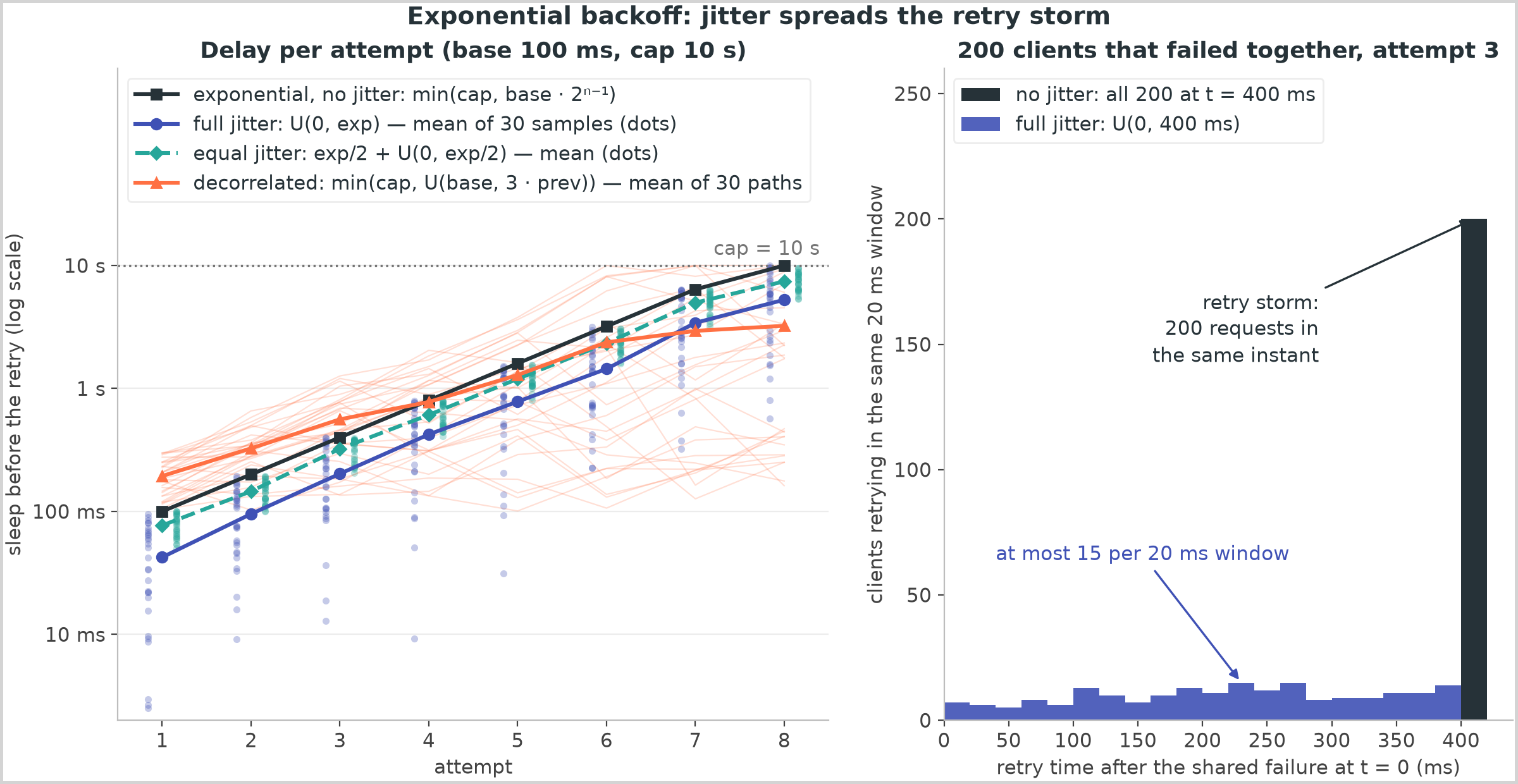
Bound the total, not the per-call count. Three attempts per call is 3x load exactly when the dependency is failing. A retry budget caps retries as a fraction of traffic: a failed attempt spends a token, a success earns a fraction back, retries stop below half full. With the gRPC defaults (100 tokens, ratio 0.1) a dead dependency gets ~50 retries before the throttle closes — 1.37x amplification in the demo instead of 4x. And retry at one layer only.
Circuit breakers
Retries help when the failure is transient. When the dependency is genuinely down, the useful behaviour is to stop calling it: fail in microseconds, free the threads, give it room to recover. Closed, calls pass and outcomes land in a sliding window; once the failure rate crosses a threshold with enough volume behind it the breaker opens and rejects locally; after a cooldown it admits a few trial calls.
Trip on a failure rate over a window with a minimum call count, never on N consecutive failures — at 1k QPS five in a row is 5 ms of noise, while a bare rate opens on the first failure of a quiet minute. Count slow calls as failures: answering at 10x the p99 exhausts pools just as surely as returning 500s.
Closed, open, half-open: the only timed transition is the cooldown.
stateDiagram-v2
    [*] --> Closed
    Closed --> Closed : outcome recorded in the sliding window
    Closed --> Open : failure rate over the threshold, with min_calls behind it
    Open --> Open : call rejected locally in microseconds
    Open --> HalfOpen : cooldown elapsed, checked lazily on the next call
    HalfOpen --> HalfOpen : trial slots busy, reject
    HalfOpen --> Closed : success_threshold trial calls succeed
    HalfOpen --> Open : one trial call fails
Bulkheads and shuffle sharding
A bulkhead partitions a resource so one failure cannot consume all of it: a connection or thread pool per dependency, so a recommendation service holding 20 of 200 threads can be dead while checkout still has 180. Across a fleet it is instance pools per tenant class.
Shuffle sharding is the cheap version at scale: give each customer a random 2 of 8 workers and there are 28 such pairs, so a poisoned pair takes down 1-in-28 of customers instead of everyone — a blast radius that shrinks combinatorially without dedicated capacity.
Load shedding and admission control
When demand exceeds capacity something gets dropped; the only choice is whether you choose. Shedding rejects excess work at the door with 429 or 503 and Retry-After, by priority — health checks before background sync — triggered on saturation (queue depth or wait time) rather than CPU, because a growing queue is already failing its callers. The rule that makes it work is the cheapest possible rejection: if rejecting costs as much as serving, you have not shed load.
Graceful degradation, fallbacks and hedged requests
Decide up front which parts of a response are essential. A product page without recommendations is a product page; without the price it is a bug. Every non-essential dependency gets a fallback — a stale cache entry, a default, a hidden section — labelled, with a cap on staleness.
Hedged requests attack the tail rather than the failure: send to one replica, and if there is no answer by the p95 send a second copy elsewhere and take the first. Only 5% of requests are hedged, so the extra load is ~5% while p99 collapses towards p95. Hedge idempotent reads only, cap the rate, cancel the loser.
A deadline set once at the edge, a hedge at the p95, a labelled stale fallback when both miss.
sequenceDiagram
    autonumber
    actor U as User
    participant GW as API gateway
    participant SVC as Ranking service
    participant RA as Replica A
    participant RB as Replica B
    participant CA as Fallback cache
    U->>GW: GET /home
    Note over GW: deadline 300 ms, stamped once at the edge
    GW->>SVC: rank(user), 280 ms of budget left
    SVC->>RA: score request
    Note over SVC: no answer by the 40 ms p95
    SVC->>RB: hedged copy of the same request
    alt a replica answers inside the budget
        RB-->>SVC: scores at 65 ms
        Note over SVC: first answer wins, the loser is cancelled
        SVC-->>GW: ranked items
        GW-->>U: 200 personalised home page
    else both miss the deadline
        SVC-->>GW: deadline exceeded at 280 ms
        GW->>CA: last good ranking for this user
        CA-->>GW: ranking cached 4 minutes ago
        GW-->>U: 200 degraded page, response header marks it stale
endBackpressure
Backpressure is the signal that flows backwards: a consumer that cannot keep up slows its producer instead of buffering. An unbounded queue is not a buffer but a delay pump — at 10k messages/s arriving and 8k/s consumed it grows 2k/s until memory runs out. Bound every queue and choose the policy when it fills: block the producer (TCP's own mechanism), drop the oldest, or reject. In a streamed system the queue is the log and the signal is consumer lag.
Cascading failures and chaos engineering
The failure mode that takes down whole systems is a loop: a slow dependency fills caller pools, callers time out and retry, retries add load, the dependency slows further. Every pattern above cuts that loop somewhere. Restart is its own trap: a service that survived at a 95% cache hit rate sends 20x the traffic to the database while cold.
The availability arithmetic explains the urgency: dependencies in series multiply, so four at 99.9% give 99.6% — ~2.9 hours a month instead of 43.8 minutes — and breakers and fallbacks are what remove a dependency from that product. None of it is real until injected deliberately: kill an instance, add 500 ms of latency, blackhole a dependency, first in staging and then in production with a small blast radius and an abort switch.
Trade-offs
| Pattern | Protects against | Cost when wrong | Key setting |
|---|---|---|---|
| Timeout + deadline | Threads held by slow calls | Healthy calls fail | p99 x 2-5, propagated |
| Retry with jitter | Blips, a bad replica | Amplifies an outage | Attempts, jitter, budget |
| Circuit breaker | A dependency that is down | Flaps, hides capacity | Rate + volume + cooldown |
| Bulkhead | One dependency eating the pool | Idle capacity | Pool per dependency |
| Load shedding | Overload, queue collapse | Rejects servable work | Queue depth, priorities |
| Fallback | Non-essential dependency down | Silent stale data | Staleness cap, label |
| Hedged request | Tail latency | Extra load if uncapped | Hedge at p95, cap it |
| Backpressure | Producers outrunning consumers | Blocks the wrong caller | Bounded queue, policy |
Start with timeouts everywhere: they cost nothing and every other pattern assumes them. Add a deadline budget once the call chain is deeper than two hops. Retries with jitter come next, on idempotent operations only, at one layer, with a budget. Reach for a circuit breaker when failure is sustained rather than random — in front of a dependency that fails 1% of calls at random, a breaker only flaps. Bulkheads matter when one process calls several dependencies of unequal importance; if it calls exactly one, the timeout already is your bulkhead. Load shedding is mandatory for anything with an open front door, because the alternative is deciding by queueing, which serves nobody. Fallbacks are a product decision as much as a technical one: ask the interviewer which fields the page can live without. Hedging is the specialist tool for high fan-out idempotent reads with a tail problem. Backpressure is not optional anywhere a queue exists.
Python implementation
BackoffPolicy yields the sleep before each retry; the jitter schemes differ only in how they draw from the capped exponential:
class Jitter(StrEnum):
    """How much randomness to mix into the exponential delay."""

    NONE = "none"  # sleep = exp; synchronised clients stay synchronised
    FULL = "full"  # sleep = U(0, exp); the best spread, the shortest mean wait
    EQUAL = "equal"  # sleep = exp/2 + U(0, exp/2); spread with a guaranteed minimum pause
    DECORRELATED = "decorrelated"  # sleep = min(cap, U(base, 3 * previous)); grows on its own


@dataclass(frozen=True, slots=True)
class BackoffPolicy:
    """Exponential backoff with a cap, a bounded number of attempts and a jitter scheme.

    ``max_attempts`` counts the first call, so 4 attempts means 1 call and up to 3 retries.
    Cap the delay: uncapped doubling from 100 ms reaches 100 ms x 2^9 = 51 s by attempt 10,
    long past any request timeout the caller is willing to hold.
    """

    base_seconds: float = 0.1
    cap_seconds: float = 10.0
    multiplier: float = 2.0
    max_attempts: int = 4
    jitter: Jitter = Jitter.FULL

    def __post_init__(self) -> None:
        if self.base_seconds <= 0 or self.cap_seconds < self.base_seconds:
            raise ValidationError("need 0 < base_seconds <= cap_seconds")
        if self.multiplier < 1:
            raise ValidationError("multiplier must be >= 1")
        if self.max_attempts < 1:
            raise ValidationError("max_attempts must be >= 1")

    def exponential(self, attempt: int) -> float:
        """The unjittered delay before retry ``attempt`` (1-based): min(cap, base * m^(n-1))."""
        if attempt < 1:
            raise ValidationError("attempt is 1-based")
        return min(self.cap_seconds, self.base_seconds * self.multiplier ** (attempt - 1))

    def delays(self, rng: random.Random) -> Iterator[float]:
        """The ``max_attempts - 1`` sleeps between attempts, drawn from ``rng``."""
        previous = self.base_seconds
        for attempt in range(1, self.max_attempts):
            exp = self.exponential(attempt)
            match self.jitter:
                case Jitter.NONE:
                    sleep = exp
                case Jitter.FULL:
                    sleep = rng.uniform(0.0, exp)
                case Jitter.EQUAL:
                    sleep = exp / 2 + rng.uniform(0.0, exp / 2)
                case Jitter.DECORRELATED:
                    sleep = min(self.cap_seconds, rng.uniform(self.base_seconds, previous * 3))
            previous = sleep
            yield sleep
RetryBudget is the gRPC and Envoy throttle: a token bucket over outcomes, so retries switch themselves off during a real outage:
class RetryBudget:
    """A token bucket that caps retries as a *fraction* of traffic, not per call.

    Per-call limits do not bound the amplification: 3 attempts each turns a dependency's bad
    minute into 3x the load exactly when it can least take it. A budget does. Every failed
    attempt spends a token, every success earns ``token_ratio`` back, and retries stop while
    the bucket is under half full, so a healthy service retries freely and a dead one is not
    retried at all. With the gRPC defaults (100 tokens, ratio 0.1) a total outage allows ~50
    retries before the throttle closes; steady state allows one retry per 10 successes, and
    the extra load a retrying fleet can add is bounded at ~10%.

    ``_lock`` guards ``_tokens``.
    """

    def __init__(self, max_tokens: float = 100.0, token_ratio: float = 0.1) -> None:
        if max_tokens <= 0:
            raise ValidationError("max_tokens must be positive")
        if not 0 < token_ratio <= 1:
            raise ValidationError("token_ratio must be in (0, 1]")
        self._max_tokens = float(max_tokens)
        self._token_ratio = float(token_ratio)
        self._tokens = float(max_tokens)
        self._lock = threading.Lock()

    @property
    def tokens(self) -> float:
        with self._lock:
            return self._tokens

    @property
    def max_tokens(self) -> float:
        return self._max_tokens

    def allows_retry(self) -> bool:
        """Retries are allowed only while the bucket is more than half full."""
        with self._lock:
            return self._tokens > self._max_tokens / 2

    def record(self, ok: bool) -> None:
        """One attempt's outcome: a failure costs a token, a success earns ``token_ratio``."""
        with self._lock:
            delta = self._token_ratio if ok else -1.0
            self._tokens = max(0.0, min(self._max_tokens, self._tokens + delta))
Retrier.call draws the delay sequence in one locked step and re-raises the last failure:
@dataclass(frozen=True, slots=True)
class RetryStats:
    """Aggregate counters for one ``Retrier``, which usually guards one dependency."""

    calls: int  # calls made through the retrier
    attempts: int  # individual invocations of the wrapped callable
    failures: int  # attempts that raised a retryable exception
    slept_seconds: float
    exhausted: int  # calls that used every attempt and still failed
    budget_denied: int  # calls that stopped early because the budget was empty

    @property
    def retries(self) -> int:
        return self.attempts - self.calls

    @property
    def amplification(self) -> float:
        """Attempts per call: what the dependency sees for every request the caller makes."""
        return self.attempts / self.calls if self.calls else 1.0


class Retrier:
    """Runs a callable until it succeeds, the attempts run out or the budget says stop.

    Retry only what is safe to repeat. A retried write that already committed is a duplicate
    charge, so a retryable write carries an idempotency key and the server deduplicates on it;
    without that, retry reads and leave writes to a single attempt plus a queue.

    ``_lock`` guards the counters and ``_rng``: the whole delay sequence for one call is drawn
    in one locked step, so a seeded generator makes single-threaded runs reproducible.
    """

    def __init__(
        self,
        policy: BackoffPolicy | None = None,
        *,
        retry_on: tuple[type[BaseException], ...] = TRANSIENT,
        budget: RetryBudget | None = None,
        rng: random.Random | None = None,
        sleep: Callable[[float], None] | None = None,
    ) -> None:
        if not retry_on:
            raise ValidationError("retry_on must name at least one exception type")
        self._policy = policy or BackoffPolicy()
        self._retry_on = retry_on
        self._budget = budget
        self._rng = rng or random.Random()
        self._sleep = sleep or time.sleep
        self._lock = threading.Lock()
        self._calls = self._attempts = self._failures = 0
        self._exhausted = self._denied = 0
        self._slept = 0.0

    @property
    def policy(self) -> BackoffPolicy:
        return self._policy

    def stats(self) -> RetryStats:
        with self._lock:
            return RetryStats(
                self._calls, self._attempts, self._failures, self._slept, self._exhausted, self._denied
            )

    def call[**P, R](self, fn: Callable[P, R], *args: P.args, **kwargs: P.kwargs) -> R:
        """Call ``fn``, retrying the named exceptions; the last failure is re-raised as it is."""
        with self._lock:
            self._calls += 1
            delays = list(self._policy.delays(self._rng))
        for attempt in range(1, self._policy.max_attempts + 1):
            with self._lock:
                self._attempts += 1
            try:
                result = fn(*args, **kwargs)
            except self._retry_on:
                with self._lock:
                    self._failures += 1
                if self._budget is not None:
                    self._budget.record(ok=False)
                if attempt == self._policy.max_attempts:
                    with self._lock:
                        self._exhausted += 1
                    raise
                if self._budget is not None and not self._budget.allows_retry():
                    with self._lock:
                        self._denied += 1
                    raise
                pause = delays[attempt - 1]
                self._sleep(pause)
                with self._lock:
                    self._slept += pause
                continue
            if self._budget is not None:
                self._budget.record(ok=True)
            return result
        raise ValidationError("unreachable: max_attempts must be >= 1")  # pragma: no cover

    def decorate[**P, R](self, fn: Callable[P, R]) -> Callable[P, R]:
        """Wrap ``fn`` so every call goes through this retrier (and shares its stats)."""

        @functools.wraps(fn)
        def wrapper(*args: P.args, **kwargs: P.kwargs) -> R:
            return self.call(fn, *args, **kwargs)

        return wrapper


def retry[**P, R](
    policy: BackoffPolicy | None = None,
    *,
    retry_on: tuple[type[BaseException], ...] = TRANSIENT,
    budget: RetryBudget | None = None,
    rng: random.Random | None = None,
    sleep: Callable[[float], None] | None = None,
) -> Callable[[Callable[P, R]], Callable[P, R]]:
    """Decorator form: ``@retry(BackoffPolicy(jitter=Jitter.FULL), budget=shared_budget)``."""
    return Retrier(policy, retry_on=retry_on, budget=budget, rng=rng, sleep=sleep).decorate
Running uv run python -m hld.retry:
backoff from base 100 ms, cap 10 s, 6 attempts
  none              100     200     400     800    1600   total  3.10 s
  full               64       5     110     179    1178   total  1.54 s
  equal              82     103     255     489    1389   total  2.32 s
  decorrelated      228     115     167     190     445   total  1.14 s

200 clients fail together; attempt 3 sleeps 400 ms; count the worst 20 ms window
  none          at most 200 of 200 clients retry in the same 20 ms
  full          at most  20 of 200 clients retry in the same 20 ms
  equal         at most  32 of 200 clients retry in the same 20 ms

two transient timeouts then success -> 'ok'
  3 attempts for 1 call (amplification 3.0x), slept 63 ms

total outage, 100-token budget, 100 calls: the throttle closed on call 13 at half full; 0 tokens left after all 100 calls
  137 attempts for 100 calls = 1.37x load on a dying dependency, instead of 4x without a budget
That last block is the argument for budgets: same code, same policy, 400 attempts without one and 137 with it.
CircuitBreaker holds one lock over every field and never calls the dependency while holding it. Each admitted call gets a Permit stamped with the current generation, so a result arriving after a reopen cannot corrupt the new episode:
class CircuitBreaker:
    """The state machine. ``_lock`` guards every field; the dependency runs outside it.

    CLOSED -> OPEN when the windowed failure rate trips; OPEN -> HALF_OPEN lazily, on the
    first call or state read after ``open_seconds`` (no timer thread); HALF_OPEN -> CLOSED
    after ``success_threshold`` trial successes; HALF_OPEN -> OPEN on one trial failure. Every
    transition bumps ``_generation`` and resets the trial counters, which is what makes an
    outcome reported for an earlier episode harmless.
    """

    def __init__(
        self,
        name: str,
        policy: BreakerPolicy | None = None,
        clock: Clock | None = None,
        on_transition: Callable[[str, State, State], None] | None = None,
    ) -> None:
        if not name:
            raise ValidationError("name must be non-empty")
        self._name = name
        self._policy = policy or BreakerPolicy()
        self._clock = clock or SystemClock()
        self._on_transition = on_transition
        self._lock = threading.Lock()
        self._state = State.CLOSED
        self._generation = 0
        self._window: deque[tuple[float, bool]] = deque()  # (recorded_at, ok) while closed
        self._window_failures = 0
        self._opened_at = 0.0
        self._trials_in_flight = 0
        self._trial_successes = 0
        self._rejected = 0

    @property
    def name(self) -> str:
        return self._name

    @property
    def state(self) -> State:
        with self._lock:
            event = self._tick(self._clock.now())
            state = self._state
        self._emit(event)
        return state

    def call[**P, R](self, fn: Callable[P, R], *args: P.args, **kwargs: P.kwargs) -> R:
        """Run ``fn`` through the breaker: admit, call outside the lock, record the outcome."""
        permit = self.acquire()
        try:
            result = fn(*args, **kwargs)
        except self._policy.ignored_exceptions:
            self.release(permit)
            raise
        except Exception:
            self.record(permit, ok=False)
            raise
        slow = self._policy.slow_call_seconds
        self.record(permit, ok=slow is None or self._clock.now() - permit.issued_at < slow)
        return result

    def acquire(self) -> Permit:
        """Admit a call or raise ``CircuitOpenError``; half-open admits a bounded number of trials."""
        with self._lock:
            now = self._clock.now()
            event = self._tick(now)
            outcome = self._admit_locked(now)
        self._emit(event)
        if isinstance(outcome, CircuitOpenError):
            raise outcome
        return outcome

    def record(self, permit: Permit, ok: bool) -> None:
        """Report the outcome of an admitted call (a timeout is a failure)."""
        self._settle(permit, ok)

    def release(self, permit: Permit) -> None:
        """Hand a permit back without a verdict: the failure was the caller's, not the dependency's."""
        self._settle(permit, None)

    def reset(self) -> None:
        """Operator override: close the breaker now and forget the window."""
        with self._lock:
            event = self._transition(State.CLOSED, self._clock.now())
        self._emit(event)

    def snapshot(self) -> BreakerStats:
        with self._lock:
            now = self._clock.now()
            event = self._tick(now)
            self._prune(now)
            retry_after = 0.0
            if self._state is State.OPEN:
                retry_after = max(0.0, self._opened_at + self._policy.open_seconds - now)
            stats = BreakerStats(
                self._state, len(self._window), self._window_failures, self._rejected, retry_after
            )
        self._emit(event)
        return stats

    # -- everything below runs under ``_lock`` ------------------------------------------------
    def _admit_locked(self, now: float) -> Permit | CircuitOpenError:
        policy = self._policy
        if self._state is State.OPEN:
            self._rejected += 1
            return CircuitOpenError(self._name, State.OPEN, self._opened_at + policy.open_seconds - now)
        if self._state is State.HALF_OPEN:
            if self._trials_in_flight >= policy.half_open_max_calls:
                self._rejected += 1
                return CircuitOpenError(self._name, State.HALF_OPEN, 0.0)
            self._trials_in_flight += 1
            return Permit(self._generation, trial=True, issued_at=now)
        return Permit(self._generation, trial=False, issued_at=now)

    def _settle(self, permit: Permit, ok: bool | None) -> None:
        with self._lock:
            event = self._settle_locked(permit, ok, self._clock.now())
        self._emit(event)

    def _settle_locked(self, permit: Permit, ok: bool | None, now: float) -> tuple[State, State] | None:
        if permit.generation != self._generation:
            return None  # an earlier episode: a reopen or a reset already reset the counters
        if permit.trial:
            self._trials_in_flight -= 1
        if ok is None:
            return None
        policy = self._policy
        if self._state is State.CLOSED:
            self._window.append((now, ok))
            if not ok:
                self._window_failures += 1
            self._prune(now)
            calls = len(self._window)
            if calls >= policy.min_calls and self._window_failures / calls >= policy.failure_rate_threshold:
                return self._transition(State.OPEN, now)
            return None
        if not ok:  # a half-open trial failed: straight back to open
            return self._transition(State.OPEN, now)
        self._trial_successes += 1
        if self._trial_successes >= policy.success_threshold:
            return self._transition(State.CLOSED, now)
        return None

    def _tick(self, now: float) -> tuple[State, State] | None:
        """The only timed transition: open -> half-open once ``open_seconds`` have passed."""
        if self._state is State.OPEN and now >= self._opened_at + self._policy.open_seconds:
            return self._transition(State.HALF_OPEN, now)
        return None

    def _prune(self, now: float) -> None:
        horizon = now - self._policy.window_seconds
        while self._window and self._window[0][0] <= horizon:
            _, ok = self._window.popleft()
            if not ok:
                self._window_failures -= 1

    def _transition(self, new: State, now: float) -> tuple[State, State]:
        old, self._state = self._state, new
        self._generation += 1
        self._trials_in_flight = 0
        self._trial_successes = 0
        if new is State.OPEN:
            self._opened_at = now
        elif new is State.CLOSED:
            self._window.clear()
            self._window_failures = 0
        return old, new

    def _emit(self, event: tuple[State, State] | None) -> None:
        """Listeners run outside the lock, so they may call back into the breaker."""
        if event is not None and event[0] is not event[1] and self._on_transition is not None:
            self._on_transition(self._name, *event)
Running uv run python -m hld.circuit_breaker:
policy: open at >= 50% failures over the last 10 s (min 10 calls); open for 5 s; 1 trial call at a time; 2 trial successes close
t=0 s: 10 calls, 6 of them time out
    payments: closed -> open at t=0 s
  4 ok, 6 failed; failure rate 60% over 10 calls -> open
t=0 s: 5 more calls: 5 x 'rejected, retry after 5 s'; the dependency saw 10 calls
t=5 s: the first call after open_seconds is the trial call, and it times out
    payments: open -> half_open at t=5 s
    payments: half_open -> open at t=5 s
  failed
t=10 s: two trial calls succeed
    payments: open -> half_open at t=10 s
    payments: half_open -> closed at t=10 s
  ok, ok
a ValidationError passes through uncounted: window holds 0 calls
a 1.5 s call against a 1.0 s slow-call threshold returns 'ok' but counts as a failure: window 1 call, 1 failure
nine more timeouts reopen the breaker, then 1,600 calls arrive at once
    payments: closed -> open at t=12 s
16 threads x 100 calls while open: 1600 rejected in microseconds, the dependency saw 0 of them
The last line is the point: 1,600 concurrent calls, none reaching a dependency that cannot serve them, each rejection costing an uncontended lock (~17 ns) rather than a 500 µs round trip.
In the interview
Introduce it at the first synchronous arrow to something you do not own: "200 ms timeout from its 40 ms p99, retries on timeouts only with full jitter behind a shared budget, a breaker so an outage costs microseconds instead of threads, and the last good cached value, marked stale, while it is down."
Phrases that signal depth: "the deadline is stamped at the edge and every hop passes the remaining budget down"; "retry at one layer, with a budget, on idempotent calls only"; "count slow calls as failures".
What timeout do you set, and how do you choose the number?
From the measured distribution, not a round number: p99 x 2-5, so a 40 ms p99 gets ~200 ms. Then check it against the caller's deadline — anything longer than the remaining budget is decoration.
A dependency's p99 goes from 40 ms to 5 s. Walk me through what happens.
Little's law: in-flight goes from 1,000 x 0.04 = 40 to 1,000 x 5 = 5,000, so a 200-thread pool saturates in ~200 ms. The timeout caps the hold, the bulkhead confines it, the breaker opens on the slow-call rate.
Why is jitter more important than the backoff itself?
Backoff spreads one client's attempts over time; jitter spreads all clients over each other. Without it, 200 clients that failed together retry in the same millisecond and knock the recovering dependency over.
How do you keep retries from amplifying an outage?
A retry budget: retries as a fraction of traffic, spent per failure and earned per success, off below half full. Plus one retrying layer only.
The breaker is open but the dependency has recovered. How long until you notice?
At most the cooldown: the first call after it elapses becomes the trial call, checked lazily so no timer thread is needed. Limit trials to one or two.
Interview tip
Give the numbers, not the vocabulary. "Circuit breaker, retries, bulkhead" is a word list; "200 ms timeout from a 40 ms p99, three attempts with full jitter behind a 10% retry budget, breaker at a 50% failure rate over 10 s" is someone who has run it.
Common mistakes
- No timeout, or the library default: a 30-second default plus a slow dependency exhausts the pool and takes down endpoints that never touched it. Fix: set both timeouts from measured percentiles.
- Retrying every error class: a retried 400 repeats a request guaranteed to fail. Fix: retry timeouts, connection errors, 429 and 503; never a 4xx that describes the request.
- Thresholds that never trip or always trip: "5 consecutive failures" is 5 ms of noise at 1k QPS; a bare rate opens on the first error of a quiet minute. Fix: a rate, a minimum call count and a window.
- Unbounded queues before a slow consumer: latency grows without limit and the process dies on memory. Fix: bound every queue and alert on lag.
- A fallback that fails or lies: one calling the same database is not a fallback, and unlabelled stale data is a correctness bug. Fix: keep fallbacks local, mark degraded responses.
Common mistake
Retrying at every layer. Gateway, service and client library each retry: three attempts at three layers is 27 requests for one user action, in a synchronised burst exactly when the dependency is weakest. Pick one layer — the one closest to the dependency, which knows what is idempotent — and make the rest fail fast.
Self-check
Why does a deadline budget beat per-call timeouts in a chain of services?
Per-call timeouts multiply down the chain, so the user waits far longer than any single limit. A deadline is stamped once and decremented at each hop, so a hop with no time left fails at once.
What must be true before you may retry a write?
It must be idempotent, usually via an idempotency key the server deduplicates on. A timeout does not say whether the write committed, so without dedup a retry risks duplicating it.
Full, equal or decorrelated jitter: what actually differs?
Full jitter (U(0, exp)) spreads best and waits least but can retry almost immediately. Equal jitter keeps a minimum pause at half the spread. Decorrelated jitter derives each sleep from the last. Any beats none.
Why must a circuit breaker count slow calls as failures?
Thread exhaustion comes from calls that answer late, not from calls that fail fast: a dependency answering correctly at 10x its p99 fills every caller's pool while a success-rate breaker stays closed.
Your queue fills faster than the consumer drains it. Name three legitimate policies.
Block the producer, drop the oldest or lowest-priority items, or reject new work with a retryable status. Letting it grow is the illegitimate answer.
Related
- Messaging, queues and Kafka internals — consumer lag as the backpressure signal
- Observability, SLOs and error budgets — the saturation signals these patterns key off
- Load balancing, reverse proxies and API gateways — health checks, outlier ejection and where shedding lives
- Rate limiting — admission control per caller
- Design a notification system — retries, DLQs and provider failover end to end
- Marc Brooker, "Exponential Backoff and Jitter" (AWS Architecture Blog, 2015)
- Dean and Barroso, "The Tail at Scale" (CACM, 2013)
- Google SRE Book, "Addressing Cascading Failures" (2016)